Boston, MA · Founded 2026 · Pre-incorporation

Fitness apps don't fail at tracking. They fail at making you come back.

Not Another Fitness App is a fitness and wellness software company. We build products that borrow their retention mechanics from games rather than spreadsheets, because the hard part of health is not measurement. It is showing up again tomorrow.

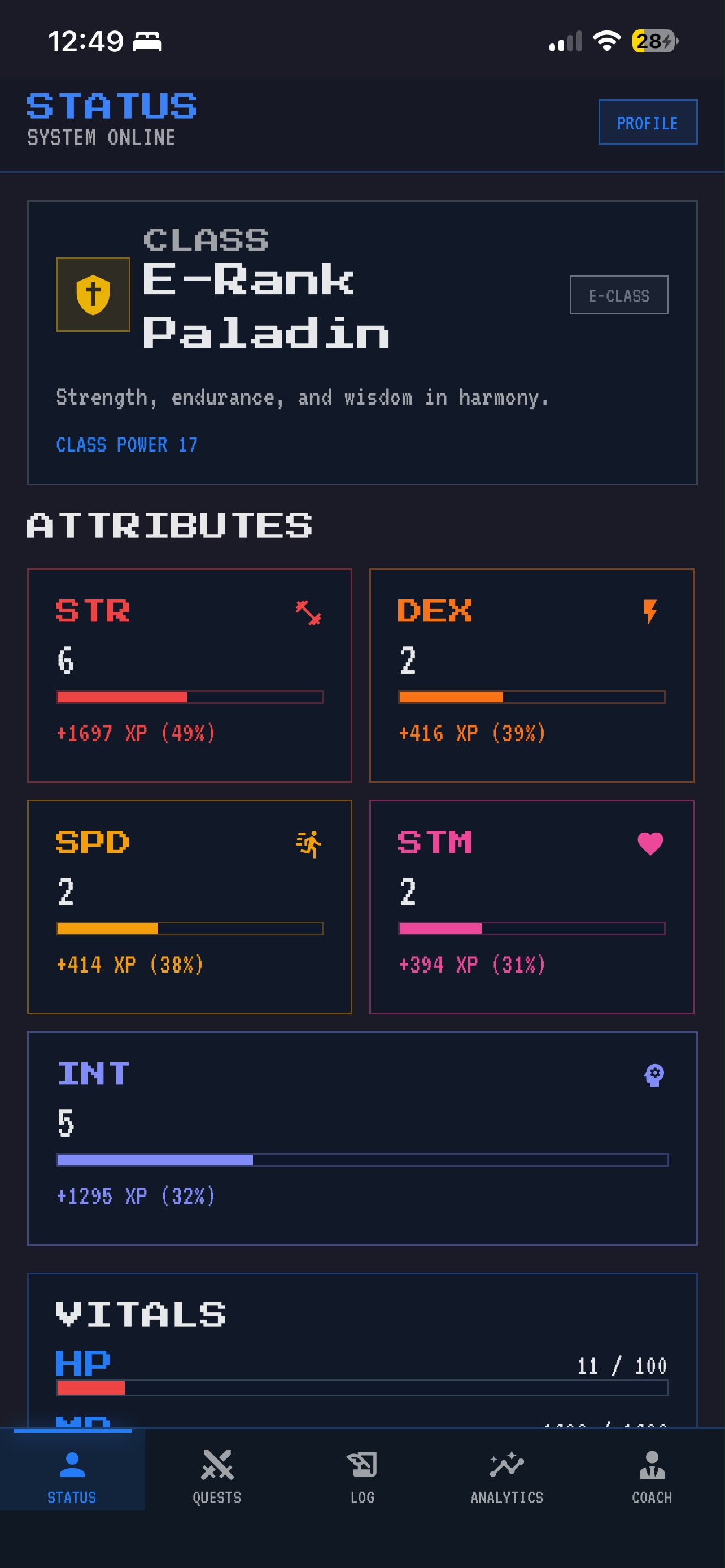
Our first product, Respawn, reads a person's real health data and renders it as a live RPG character sheet. Every workout, meal, and night of sleep becomes XP toward a stat they can watch move. It is in closed TestFlight beta today with 50 testers.

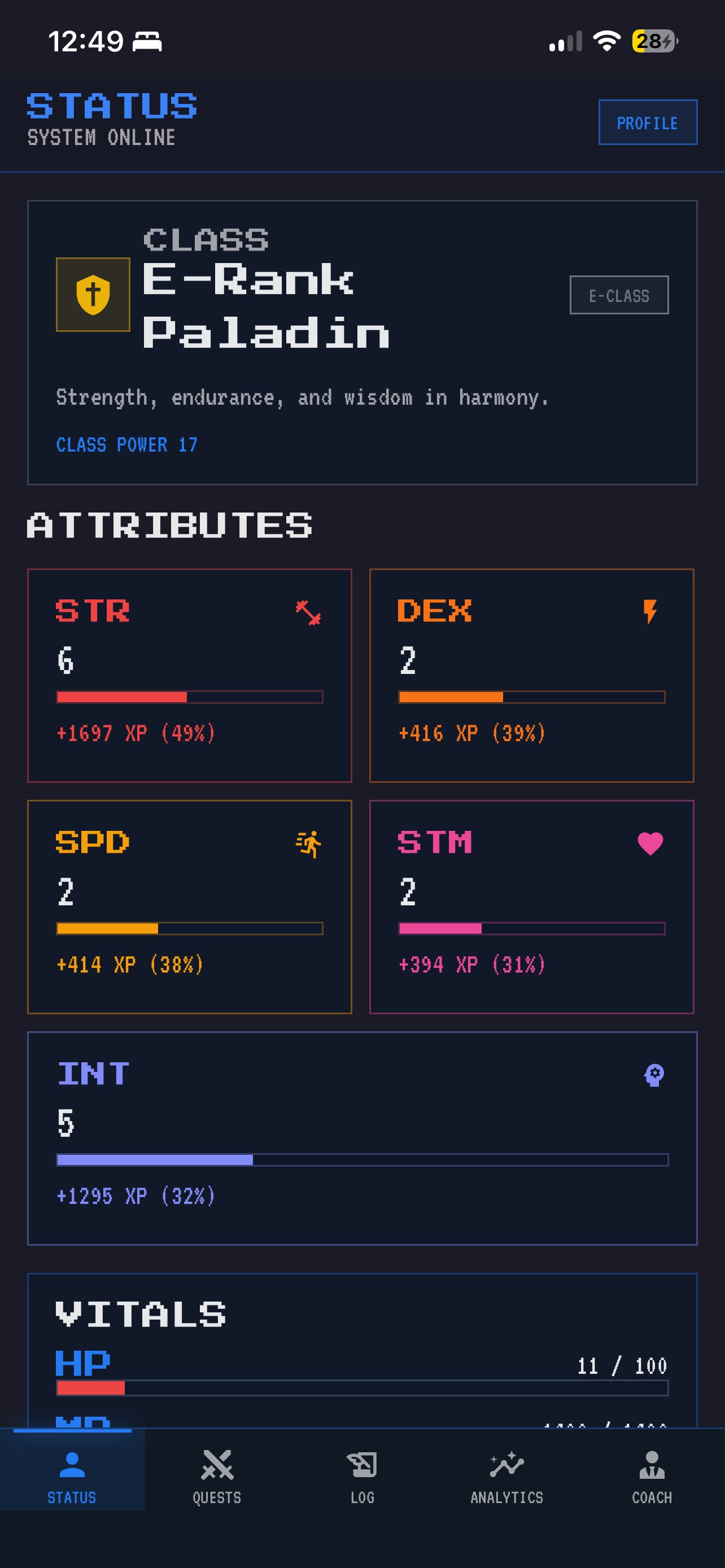
The Respawn app STATUS screen: an E-Rank Paladin class card above STR, DEX, SPD, STM and INT attribute cards with XP progress bars.
Respawn: a live character sheet, generated from Apple Health and Health Connect data.
50Closed beta testers
2ndPlace, Google Expo (Cambridge)
5Core app surfaces shipped
2026Founded in Boston, MA
// 01 / Company

What we do, and who we do it for

We are a small fitness and wellness software team applying game design to health behaviour change. We are not a gym, a coaching service, or a wearable manufacturer. We build the software layer that sits on top of the health data people already generate, and make acting on it feel like progress rather than paperwork.

01

The problem

Health tracking is a solved problem. Health adherence is not. Phones and wearables already capture steps, workouts, heart rate, sleep, and nutrition. The apps built on that data present it as a dashboard, a set of charts that report what already happened, with nothing that makes tomorrow feel worth showing up for.

The result is measurable at both ends. Globally, 31% of adults, about 1.8 billion people, did not meet WHO physical activity recommendations in 2022, and that share is projected to reach 35% by 2030.1 Meanwhile the apps meant to help lose almost everyone: industry benchmarks put day-30 retention for the health and fitness category at roughly 3% of installs.2

02

Our solution

We wrap that same health data in a progression system that games have spent forty years refining: persistent stats, levels, ranked tiers, daily quests, and a visible consequence for skipping a day. In Respawn, a lifting session raises Strength. A long run raises Speed and Stamina. Sleep and recovery restore vitals.

Nothing is invented. Every point of XP is traceable to something the user's body actually did, which is what separates a progression system from a novelty. The result is a loop with a reason to return daily, built entirely on data the user already produces.

03

Who it's for

Primary: adults roughly 18 to 30 who are fluent in games and RPG progression, own a phone and often a wearable, and want to be fitter, but have bounced off conventional fitness apps because those apps read like accounting software. This is not a niche: 212.3 million Americans play video games, and 67% of Americans play more than an hour a week.3

Secondary: anyone trying to trade screen time for physical activity, and lapsed users of mainstream tracking apps who are looking for a reason to restart.

Launch market: United States, iOS first, expanding to Android.

Every fitness app asks the user to be disciplined. We think that is the bug, not the user. Build the loop correctly and the discipline is a side effect.

Where Respawn came from

Respawn started as a question about learning, not fitness. What if studying could be gamified and folded into a healthy daily habit? The obstacle was verification. Someone can log a study session without absorbing a word of it, so we paired every quest with a test and made grasping the material, not merely claiming the time, the thing that paid out.

That constraint turned out to be the entire product. Once the system rewarded verified results instead of self-reported effort, the same engine applied to the gym. A rep you say you did is a claim. A rep confirmed by your health data is a result. Respawn was born by moving that reward engine from the desk to the gym floor, and gamifying different parts of life became the thing we are proudest of.

The features followed from questions we could not stop asking. If you counted every step you have taken since the day you were born and walked them all in one direction, where would you be standing now? What would it actually take to look like the person you admire on screen? Those two questions became Journey, which turns a lifetime of movement into distance travelled, and Body Scanner, which turns an aspiration into a plan.

// 02 / Evidence & market

Why this approach, and why now

Gamified health is often dismissed as a novelty. The peer-reviewed evidence says otherwise, and it says so specifically against the comparison that matters: non-gamified interventions doing the same job.

16 randomised controlled trials 2,407 participants

Gamification measurably increases physical activity

A 2022 systematic review and meta-analysis in the Journal of Medical Internet Research pooled 16 randomised controlled trials covering 2,407 participants. It found a small to medium positive effect of gamified interventions on physical activity behaviour (Hedges g = 0.42, 95% CI 0.14 to 0.69).4

Two findings matter most for our thesis. First, gamified interventions outperformed active control groups running equivalent non-gamified physical activity programmes (g = 0.23, 95% CI 0.05 to 0.41), so the gain is not simply the effect of any intervention. Second, the effect persisted at follow-up averaging 14 weeks after the intervention ended (g = 0.15, 95% CI 0.07 to 0.23), which is direct evidence against the novelty-effect objection. The authors also found no significant difference across age, gender, BMI, or health status subgroups, suggesting the approach generalises.

$14.81B

Wellness apps market, 2026

Growing to $51.12B by 2035 at a 14.79% CAGR.5

37%

North America's share

The largest regional share of that market, with the US alone at $4.19B in 2025.5

15.05%

US CAGR to 2035

The US segment is forecast to reach $17.02B by 2035.5

67%

of Americans play games weekly

212.3 million people, average player age 37.3

Our position sits at the intersection of these two curves: a large, fast-growing wellness software market, and a mainstream audience that is already fluent in the exact mechanics the clinical literature says improve adherence.

// 03 / Products

What we're building

One product, shipped deep rather than wide. Respawn is a full consumer application, not a prototype, with five working surfaces, live health-data ingestion, an analytics pipeline, and an AI coach.

Product 01

Respawn

Turn your life into an RPG.

Closed TestFlight beta · 50 testers

Respawn connects to Apple Health and Android Health Connect and turns a person's real activity into a character sheet with five attributes (Strength, Dexterity, Speed, Stamina and Intellect) plus HP and MP vitals. Training grants XP to the matching stat. A daily quest board converts goals into concrete missions. Cleared quests bank focus time, so the app earns back the phone time it is competing with.

Above that sits an analytics layer that reads trends, energy curves and recovery, and an AI coach that turns the user's own numbers into saveable training plans.

Shipped surfaces

  • Status: the live character sheet, showing class, rank, attributes and vitals.
  • Quests: a daily board of tiered missions that convert goals into XP.
  • Log: one-tap logging for training, food, water and sleep, including meal scanning.
  • Analytics: trends, energy curves and rank forecasting from an ML pipeline.
  • Coach: an AI coach that reads the user's stats and returns saveable plans.

Development stage

  1. Concept & designGame system, attribute model and rank curve defined
  2. LevelUp prototypeEarlier build of this product placed 2nd at the Google Expo, Cambridge office, 2026
  3. Core buildFive surfaces, health-data sync, XP engine and analytics live
  4. Closed TestFlight beta (current)50 invited testers on iOS, gathering retention and engagement data
  5. Public launchApp Store, first half of September 2026
Respawn STATUS screen showing the E-Rank Paladin class card and the STR, DEX, SPD, STM, INT attribute cards with XP bars.
Status: the character sheet
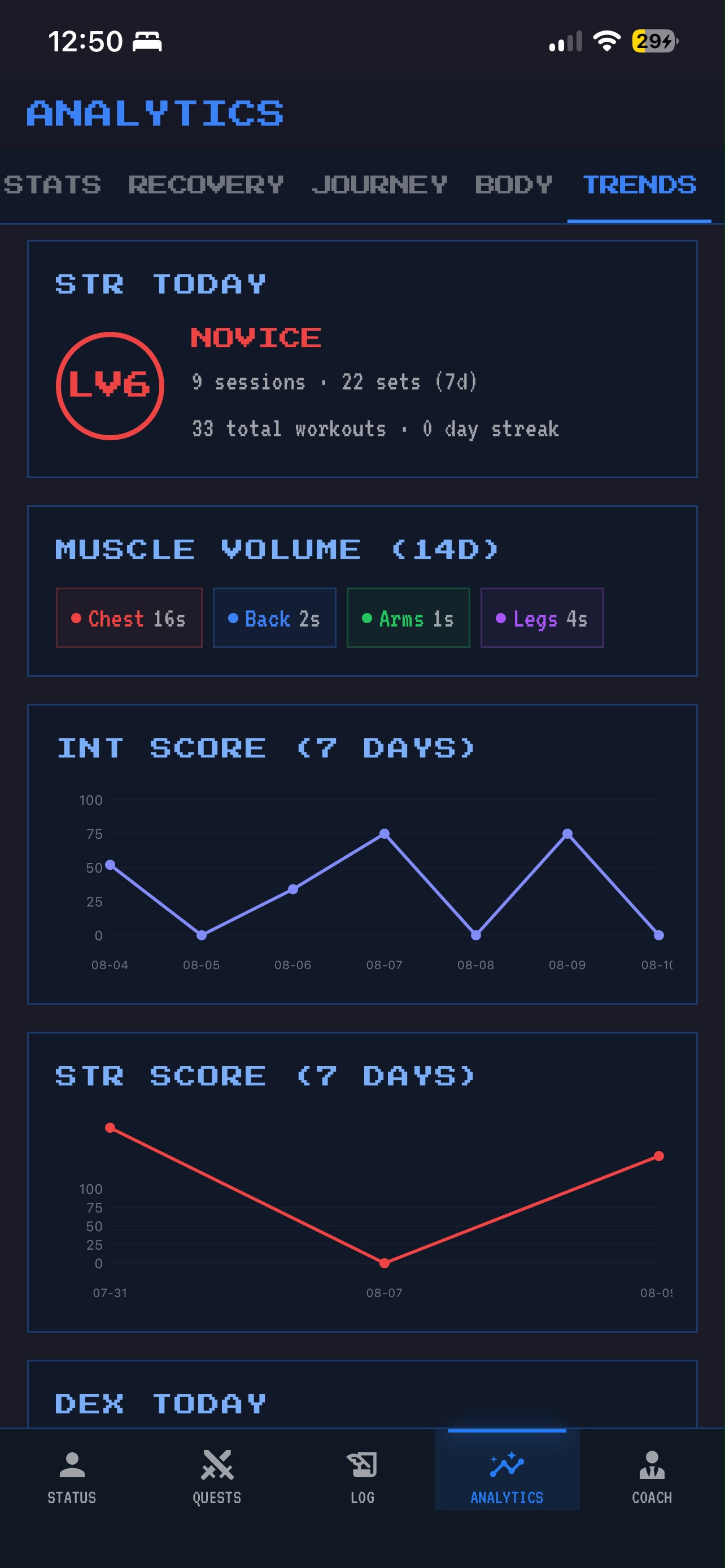
Respawn ANALYTICS trends tab showing STR level, muscle volume over 14 days, and INT and STR score line charts.
Analytics: trends & forecasting
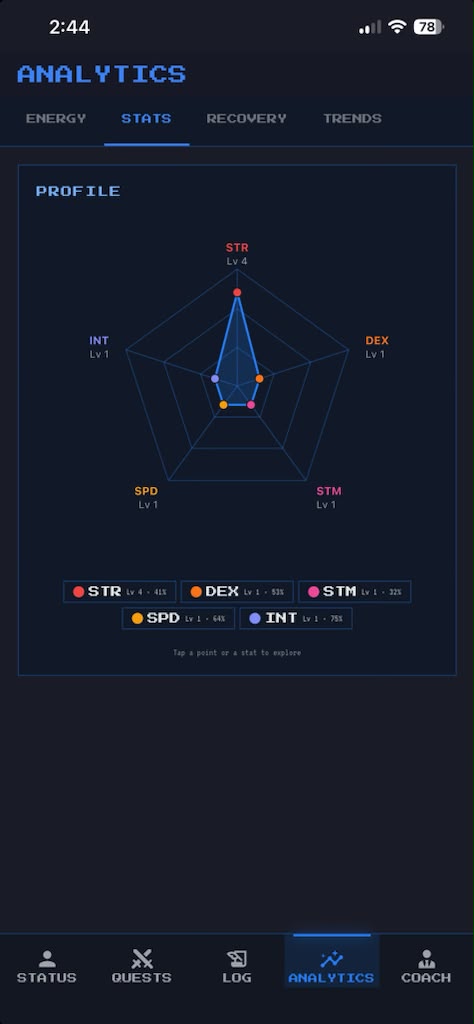
Respawn analytics profile radar chart plotting the five attributes STR, DEX, SPD, STM and INT.
Profile: attribute radar
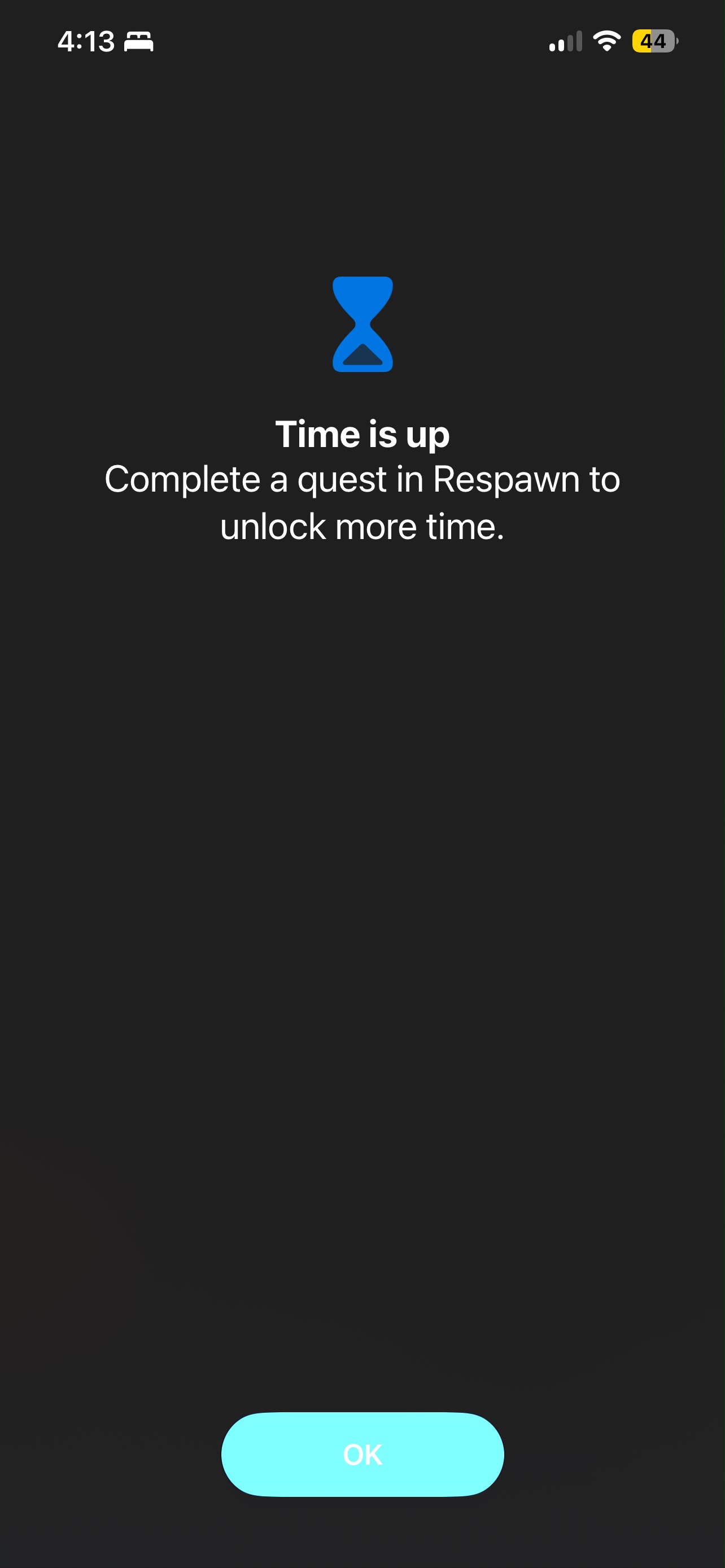
Respawn screen-time gate reading 'Time is up, complete a quest in Respawn to unlock more time.'
Focus: earned screen time

Watch it run

Product trailer, published on YouTube as “Level UP Trailer” under the product's earlier name. Nothing loads from YouTube until you press play.

What's next

  1. Sept 2026 Public release

    Out of closed beta and onto the App Store in the first half of September, with the engagement data from the 50-tester cohort behind it.

  2. Next Guild system

    Multiplayer co-op. Guilds turn a solitary progression loop into a social one, where the people you train alongside are the reason you log in on the day you would otherwise skip.

  3. Then Colleges & universities

    Onboard institutions directly. Campuses concentrate exactly our target demographic, and they already fund recreation and student wellbeing, which gives us a distribution channel that does not depend on paid consumer acquisition.

// 04 / Technology

How it's built

Respawn is a production mobile application with a real data pipeline behind it: health ingestion, an XP and progression engine, an analytics layer, and an LLM coaching surface.

Mobile client

React Native and Expo, shipping to both iOS and Android from one codebase.

Health data

Apple HealthKit and Android Health Connect stream in steps, workouts, heart rate, HRV, sleep and nutrition.

Cloud & backend

Google Cloud throughout: Firebase Authentication, Cloud Firestore, Cloud Storage, and an analytics API on Cloud Run with scale-to-zero. Infrastructure provisioned as code with Terraform.

Analytics & ML

Random Forest models trained with scikit-learn and XGBoost, then exported as JSON weights for on-device inference in pure JavaScript. Attribute scoring, energy and recovery curves, and rank forecasting run from the user's own history.

MLOps

A 10-job CI/CD pipeline covering data validation, training, quality gates, SHAP-based fairness analysis, KS/PSI drift detection with automated retraining, a versioned model registry, and 51 exported Prometheus metrics.

AI coach

Google Gemini reads the user's live stats and returns structured, saveable training plans, personalised daily quests, and adaptive quizzes.

Privacy by architecture

Privacy is our highest priority, and we enforce it in the architecture, not only in a policy document. Every claim below is written out in full in our published Privacy Policy.

  • Every machine learning model runs on the device. Energy, strength, speed, stamina, flexibility and calorie predictions are all inferred locally, so your raw health data does not need to leave your phone for the game to work.
  • Health data is opt in, per category, and revocable. Apple Health and Health Connect are read only after you grant permission, only for the categories you switch on, and are never sold or used for advertising.
  • Images and PDFs are never stored on our servers. Body Scanner photos, and any file you attach to an AI request, are processed and discarded. Nothing is retained, and nothing is tagged.
  • We store only what lets you continue. What we persist to your private Firestore account is the minimum needed to restore your character, progress and history on a new device, scoped to your user ID. You can erase all of it from inside the app.

That posture is a founder-level responsibility here rather than a later hire. Our CTO has implemented ISO 27001, ISO 27701, ISO 42001, SOC 2 and HIPAA control frameworks in production companies, and Respawn is built against those practices from the start.

// 05 / Team

Who's building it

Two founders. Respawn ingests continuous health data, which makes it as much a security and privacy problem as a product one, so we split the company along exactly that line. One of us builds the data and ML pipeline, the other has spent eight years securing consumer platforms at scale and has personally led ISO 27001, ISO 27701 and HIPAA implementations. That pairing is unusual this early, and it is deliberate.

Somesh Bachani

Somesh M. Bachani

Founder & CEO · Product, data & ML

M.S. Computer Science at Northeastern University, Boston (expected May 2026, GPA 3.91/4.0), following a B.Tech in Computer Science Engineering (AI & ML). Previously Software Engineer, Data Platform at Apple (via Cognizant), where he owned the Finance domain of Apple's GBI Teradata to Snowflake migration, moving 70+ TB and 650+ Tableau workbooks and delivering two months ahead of handover.

He built Respawn's technical core: six Random Forest models exported as JSON weights for on-device inference in pure JavaScript (the energy model reaching MAE 1.36 and R² 0.99 across 17 features with weekly auto-recalibration), a 10-job CI/CD pipeline covering SHAP-based fairness analysis and KS/PSI drift detection with automated retraining, and Terraform-provisioned Google Cloud infrastructure behind it.

Akshansh Shrivastava

Akshansh Shrivastava

Co-founder & CTO · Security, infrastructure & platform

Senior Security Engineer with 8+ years in application and cloud security. Currently Senior Security Engineer at Apnatime, leading a team of four, and previously a Security Engineer at Swiggy, where he automated AWS WAF and Cloudflare deployments via Terraform and ran penetration testing across web, Android and iOS.

He has led ISO 27001, ISO 27701, ISO 42001, SOC 2 and HIPAA certification and control implementations end to end, which is the precise skill set a company handling continuous health data needs from day one rather than after its first audit. CEH certified, with an MCA in Computer Applications.

// Sources

References

Every figure quoted on this page, with a link to the primary source.

  1. World Health Organization, “Nearly 1.8 billion adults at risk of disease from not doing enough physical activity”, 26 June 2024. Underlying study published in The Lancet Global Health. Data year: 2022.
  2. Day-30 retention for the health and fitness app category, AppsFlyer benchmark data as reported by industry aggregators, 2025 to 2026. Published benchmarks vary widely by methodology (install-based cohorts report roughly 3%, registered-user cohorts report substantially higher), so this figure is quoted as install-based. [[Optional: buy or cite one specific benchmark report directly if you want a single hard citation here.]]
  3. Entertainment Software Association, 2026 Essential Facts About the U.S. Video Game Industry.
  4. Mazeas A, Duclos M, Pereira B, Chalabaev A. “Evaluating the Effectiveness of Gamification on Physical Activity: Systematic Review and Meta-analysis of Randomized Controlled Trials.” Journal of Medical Internet Research, 2022; 24(1):e26779. DOI 10.2196/26779. Retrieved via PubMed (PMID 34982715).
  5. Precedence Research, Wellness Apps Market Size, Share and Trends, 2026 to 2035 forecast.
// Contact

Get in touch

For partnership, investment or press enquiries, or to request access to the Respawn beta.